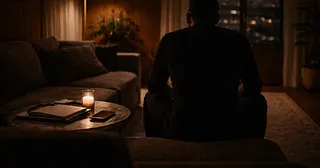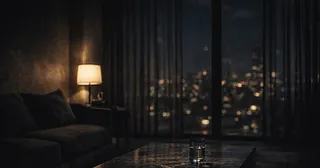
there's a moment most nights that never makes it into photos.
the door closes.
the keys land.
the room receives you.
no performance left.
no witnesses.
just the room & whatever version of you made it home.
living rooms are confessionals disguised as furniture arrangements.
they are the most honest behavioral architecture in a home.
it doesn't just reflect who you are.
it trains who you become every night.
you can read entire lives from the way a room breathes at night.
some rooms still feel like showrooms after midnight.
nothing moved.
nothing softened.
everything waiting for guests that never arrive.
others look like someone actually lives there.
a book left open.
a glass with the last inch of something amber.
a lamp doing more work than the ceiling lights ever could.
rooms tell the truth about a life before language ever can.
because environment edits behavior quietly.
it lowers some impulses.
it amplifies others.
it decides whether the night dissolves or stretches.
a living room is not a place to sit.
it's the emotional temperature of the home.
bedrooms are private.
kitchens are functional.
offices are aspirational.
but living rooms are honest.
it's where time collects.
the chair that always gets chosen first.
the corner that holds silence better than the rest.
the table that slowly becomes an archive of evenings.
every living room becomes a map of how someone unwinds.
you can tell who lives fast by the brightness of their lights.
you can tell who avoids silence by the absence of lamps.
overhead lighting is almost always a confession of impatience.
it floods the room instead of letting it unfold.
lamps understand time.
there are quiet rules that reveal themselves if you pay attention long enough.
the room should glow, not shine.
nothing in the room should demand attention.
everything should reward it.
a room should be able to hold silence without feeling empty.
music should sound better in the living room than anywhere else in the house.
not louder.
better.
a person should be able to sit down & feel their shoulders drop without noticing when it happened.
if the room makes you reach for your phone, something is wrong.
if the room makes you forget your phone exists, the room is working.
living rooms are where the day dissolves.
work ends in offices.
obligations end in parking lots.
but the day actually disappears in the living room.
it happens slowly. almost politely.
shoes disappear first.
then posture.
then language.
eventually the room is full of the version of you that doesn't need to explain itself.
this is the version of you the room was designed for.
most people decorate for guests.
the best rooms are arranged for recovery.
a chair that understands tiredness.
a lamp that understands late hours.
a table that understands quiet rituals.
the best living rooms don't impress anyone.
they let you exhale.
you can change a life by changing a room.
not dramatically. not all at once.
just one softer light.
one better chair.
one surface that invites stillness.
environment edits behavior in ways intention never can.
willpower is loud.
environment is quiet.
but environment wins.
most people try to change themselves.
very few change the room that shapes them nightly.
& the room always casts the final vote.
a room that feels calm makes calm easier to practice.
a room that feels warm makes solitude easier to trust.
a room that feels finished makes the day feel finished too.
every night ends somewhere.
for most lives, it ends in a living room.
the lamp turns off last.
the room returns to stillness.
the objects go back to waiting.
until tomorrow night, when the room receives you again, exactly as you left it.
ready to shape whoever makes it home.