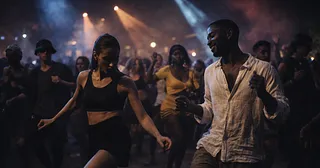
the body learns faster than the mind.
there is a point where thinking stops helping.
insight accumulates.
frameworks multiply.
language sharpens.
the baseline state remains unchanged.
the same tensions return.
the same hesitations.
the same postures.
because the mind can understand a state long before the body believes it.
thinking explains.
movement installs.
this is where music quietly enters the room.
genres are rarely treated this way.
they are discussed as taste, culture, preference, identity signals.
but their primary function is neurological.
a genre is an emotional climate with a tempo, a bass frequency & a behavioral script.
step into the room long enough & your nervous system adjusts whether you intend it to or not.
this is not metaphor.
this is physiology.
tempo entrains breath.
bass frequency alters heart rate variability.
rhythm reorganizes attention.
repetition rewires expectation.
sound does not ask permission.
it enters through the brainstem, not the cortex.
no philosophy lecture moves this quickly.
no framework bypasses resistance this cleanly.
the body changes first.
understanding arrives later—if at all.
here's what most people miss:
genres did not emerge from studios.
they emerged from conditions.
techno: industrial cities, late-stage capitalism, the need to endure.
house: post-disco, black queer liberation, the need for permission.
hip hop: systemic exclusion, the need to claim presence.
r&b: intimacy under pressure, the need to stay soft.
latin/afro/dancehall: diaspora, the need to remember the body knows.
these are not aesthetic choices.
they are behavioral solutions to environmental pressure.
each genre is a technology for navigating a specific kind of life.
& when you step into one, you are temporarily borrowing that solution.
you are rehearsing a different nervous system configuration.
techno removes relief.
no climax.
no resolution.
no story.
just forward motion.
the mind looks for variation & finds almost none.
so eventually it stops looking.
what remains is continuation.
breath deepens.
shoulders settle.
focus narrows.
time stretches.
this is not entertainment.
this is training.
techno teaches the body how to continue when the mind has no reason left.
house opens the room.
warmth enters first.
groove follows immediately.
the body softens before it realizes why.
shoulders drop.
hips loosen.
faces change.
house does not demand effort.
it invites agreement.
this is why house feels like home even in a warehouse at 3am.
it gives the body permission to feel good without earning it first.
hip hop changes stance before anything else.
weight shifts.
spine aligns.
chin lifts slightly.
confidence appears as a physical arrangement.
this is why hip hop feels confrontational even in silence.
it organizes presence.
hip hop teaches the body how to occupy space deliberately in environments designed to deny that right.
r&b moves in the opposite direction.
tempo slows.
breath lengthens.
attention turns inward.
the room becomes private even when crowded.
r&b teaches the body how to stay open without urgency.
how to remain soft without becoming vulnerable to collapse.
these rhythms bypass the intellect entirely.
hips lead.
timing loosens.
control dissolves.
this is where people laugh mid-dance.
where self-consciousness dissolves fastest.
because these genres are diaspora memory encoded in rhythm.
the body remembers it knew how to move long before it learned how to perform.
now here's the part that matters:
most modern environments are rhythmically sterile by design.
offices have no pulse.
commutes have no groove.
productivity culture has no rest.
the body is asked to perform.
never to dissolve.
this is how people become efficient, contained & quietly exhausted.
not because they're weak.
because they've been rhythmically starved.
the nervous system needs circulation.
it needs to move between states: effort & release. structure & dissolution. presence & absence.
when those cycles break, the body hardens.
not as choice.
as preservation.
the dancefloor has always been misunderstood.
it is treated as entertainment. escape. distraction.
it is closer to a laboratory.
people step into different emotional climates & test who they become inside them.
they practice new postures. new rhythms. new levels of openness.
for a few hours, the body lives ahead of the narrative.
& here's what no one says:
the body doesn't forget.
once it remembers a configuration is possible, that memory stays encoded.
not cognitively.
somatically.
this is why people leave lighter than they arrived.
not because problems disappeared.
because the nervous system remembered: other states exist. other rhythms are possible. the current arrangement is not permanent.
identity is often treated as a cognitive project.
decisions.
beliefs.
frameworks.
self-concept.
but identity actually lives in: posture. pacing. breath. reaction speed.
in the nervous system's default settings.
the body practices a state long before the mind claims it.
this is why affirmations fail.
this is why insight doesn't transfer.
this is why people "know better" but don't live better.
because knowing happens in language.
being happens in rhythm.
music accelerates this practice.
each genre becomes a safe rehearsal space for a different version of self.
endurance.
permission.
presence.
softness.
instinct.
you can visit all of them in a single night.
no explanation required.
thinking remains essential.
reflection still matters.
language still clarifies.
but movement finishes what thought begins.
the mind understands.
the body believes.
& belief, once installed physically, rarely needs convincing again.
sometimes the fastest way to change your mind is to change your rhythm.
but more often:
the fastest way to change your life
is to remember your body already knows the rhythm.